Festivus: Grievances, Strength, and the Art of Not Ruining the Relationship

Do I Seinfeld much? Apparently, yes. lol

A holiday that bravely pairs emotional honesty with wrestling. Say what bothered you all year and then prove your strength. The audacity of the sequencing alone deserves respect.

I have a soft spot for Festivus because I used to be very good at both parts. I could air a grievance with precision and passion. I could also win feats of strength without breaking a sweat. Not by physical pinning, but by logic, stamina, moral clarity, or sheer conversational dominance. If someone left the exchange a little stunned, I felt accomplished.

What I know now is this. Grievances were never the problem. Strength was never the problem. My definition of strength was.

Grievances, when done well, are acts of honesty. They are about naming impact, not assigning worth. They sound less like an attack and more like an offering. Here is what landed. Here is what stayed with me. Here is why it mattered.

Feats of strength, though, reveal our nervous systems. They show us where we believe safety lives. For a long time, I believed safety lived in winning. In being right. In leaving no room for challenge. If I pinned the moment, I felt steady. Briefly.

These days, strength looks different in my body.

It looks like telling the grievance without sharpening it.

It looks like staying present when I feel misunderstood.

It looks like resisting the urge to wrestle for control.

It looks like choosing integrity over dominance.

So if you are observing Festivus today, here is my invitation.

Air the grievances, cleanly and honestly.

Say the thing you have been carrying without turning it into a weapon.

Let the truth be the truth, not a performance.

Then, when it is time for feats of strength, try this version.

The strength to stay in the room.

The strength to listen without collapsing or attacking.

The strength to walk away with greater honesty, greater integrity, and the relationship still intact.

You can keep the pole.

You can keep the “tradition.”

Just know that the strongest thing you might do this #Festivus is leave more connected than when you arrived. It’s Festivus for the rest of us.

#MoreConnectedHumans

#IKnowFestivusIsNotreal

Accountability Is Connection Work

by Eva Vega | More Connected Humans™

Accountability has become a loaded word. In many workplaces, it’s shorthand for punishment or performance management—something that happens to someone rather than with them. But for me, and for the work we do through More Connected Humans™, accountability isn’t about consequences. It’s about connection. It’s about using conflict as a conduit for learning, growth, and repair.

Accountability, in its healthiest form, is an opportunity. It allows us to examine the gap between our intentions and our impact. It asks us to learn from dissonance rather than defend against it. And it invites us to stay in relationship—long enough to move from harm toward healing. That’s where transformation begins.

In the environments I work with—schools, nonprofits, and workplaces alike—people want accountability that restores, not accountability that punishes. They want to be part of cultures where mistakes aren’t treated as moral failures, where learning is honored, and where growth is expected of everyone.

The challenge is that the workplace often feels like one of the most high-stakes environments to get things wrong. Our livelihood, our belonging, and even our sense of self-worth are often tied to how we’re perceived at work. The fear of being wrong carries enormous stigma, and it keeps people silent. True accountability breaks that silence—it creates a pathway for reflection, repair, and reconnection.

Here’s what that looks like in practice for More Connected Humans™:

1. Accountability is relational, not punitive.

We don’t repair relationships by assigning blame. We repair them by asking questions that open understanding. Accountability requires curiosity about harm—what happened, why it mattered, and how we can make it right together. When we treat accountability as relationship work, we create belonging, not fear.

2. Repair goes beyond apology.

Apology matters—but most apologies stop short of true repair. Saying I’m sorry without understanding what went wrong or how to make things right keeps us at the surface. Real accountability means demonstrating comprehension of the harm, taking steps to address the impact, and rebuilding the relationship for the future. Repair lives in action and learning, not just remorse.

3. High accountability requires high support.

No one grows when they’re under threat. We can’t expect people to own their impact if doing so leads to humiliation or loss of safety. Accountability must be paired with compassion and structure—conditions where truth-telling and learning can coexist. Support doesn’t erase the harm; it allows repair to take root.

4. Mistakes are portals for learning.

Healthy teams normalize feedback and reflection. When someone misses the mark, we slow down and ask what can be learned. In organizations, this means moving away from punitive discipline and toward coaching cultures that prize learning over perfection.

5. Accountability is shared, not siloed.

It’s not the responsibility of HR or one brave leader to hold everyone accountable. We all participate in maintaining integrity and care. That might look like checking in after a hard meeting, revisiting a decision that landed wrong, or co-creating rituals for reflection and repair.

6. Repair is slow, embodied work.

We live in a culture that rushes through conflict. But repair doesn’t happen on a timeline. It requires nervous-system safety, patience, and a willingness to stay uncomfortable. In my work, I’ve seen how slowing down—breathing, pausing, and listening—creates more honest repair than any formal policy ever could.


Bringing Restorative Accountability into the Workplace

Shifting from punitive to restorative accountability is a cultural transformation, not a policy update. It begins with curiosity: What do we believe about accountability—and how do those beliefs shape the way people experience harm and repair here?

Across different organizations, the move toward restorative practice often starts small and grows through modeling.

At Gloucestershire County Council in the UK, staff were trained in restorative facilitation as an alternative to traditional grievance processes. Instead of launching investigations, teams began with facilitated conversations that focused on what happened, who was impacted, and what was needed for repair. Over time, the council saw fewer grievances and a stronger sense of collective responsibility.

At Pollack Peacebuilding Systems in the U.S., corporate clients use restorative circles to address workplace conflict. Circles invite all affected parties to name impact, express needs, and co-create next steps for repair. This approach helps prevent small tensions from escalating into formal complaints—saving both relationships and resources.

These examples illustrate what’s possible when organizations understand accountability as connection work. Here are a few early steps leaders can take to begin that shift:

  1. Examine your current culture of accountability.
    Ask: How do people describe the experience of being corrected or held accountable here? Is it characterized by fear, avoidance, or learning? Conduct listening sessions or surveys to surface honest feedback.
  2. Reflect on intent versus impact.
    Many punitive systems were created with good intentions—clarity, fairness, consistency—but are experienced as harsh or dehumanizing. Reflection helps distinguish between what was intended and what is actually felt.
  3. Invest in restorative practice training.
    Equip HR, managers, and team leads with skills in restorative dialogue, facilitation, and emotional literacy. Training helps them navigate conflict as an opportunity for learning rather than liability.
  4. Create spaces for repair.
    Build in structures—reflection circles, facilitated dialogues, or “impact and learning” sessions—where harm can be named and addressed collectively.
  5. Model accountability from the top.
    When leaders can admit mistakes and engage in repair publicly, they set the tone for the entire culture. Accountability becomes less about exposure and more about growth.
  6. Pair policy with practice.
    Update policies to reflect relational values, but also ensure they’re lived out in day-to-day behavior: how people speak to one another, how meetings are run, how feedback is delivered.

Accountability isn’t about being right—it’s about being willing.
Willing to look again. Willing to stay in relationship. Willing to grow through discomfort instead of hiding from it.

When we approach conflict with curiosity instead of fear, we begin to transform not just our teams but ourselves. Accountability, then, becomes the connective tissue of community—a living practice of learning, repair, and renewal.

Psychological Safety: The Foundation—and the Test—of Belonging

We all know what it feels like to hesitate before speaking. You have an idea, a question, or even a concern—but something inside you says, don’t risk it.
Maybe you’ve seen what happens to people who make mistakes. Maybe you’ve been shut down before.
That moment of hesitation is where psychological safety begins—or ends.

In today’s workplaces, many leaders discuss the importance of belonging. But belonging can’t exist without psychological safety. If people don’t feel safe enough to show up, speak honestly, or take risks, then belonging stays surface-level at best.


The Real Stakes of “Safety”

When we talk about risk at work, it’s not theoretical.
People weigh real consequences before they speak:

  • Income: “Can I afford to lose favor, hours, or stability?” “Will I lose my job?”
  • Reputation: “Will this label me as difficult or disloyal?” “Will I be seen as a leader?”
  • Social capital: “Will my peers stop including me if I say this out loud?”

These calculations happen quietly, every day.
And for employees from historically marginalized groups—who may already be navigating bias or exclusion—the stakes can be even higher.

Supervisors face their own pressures, including the expectation to “manage well,” maintain authority, and deliver results. Many are caught between the culture they want to create and the directives they must follow. Without support, they too learn to self-protect—to avoid risk instead of modeling it.


How Supervisors Shape Safety

Psychological safety lives or dies in the daily interactions between supervisors and their teams.
Supervisors hold the immediate power to signal: You’re safe here.

It’s communicated when they:

  • Admit, “I don’t have all the answers.”
  • Thank someone for honest feedback, even when it’s hard to hear.
  • Step in to protect someone who takes a social or professional risk.

When these behaviors are absent, self-protection replaces engagement—and innovation, honesty, and belonging stall.


Professional Development for Risk Tolerance

Organizations often train supervisors in compliance, evaluation, and technical skills—but rarely in relational risk management: how to stay curious under pressure, how to navigate emotions, and how to de-escalate fear.
Building risk tolerance—for both supervisors and employees—requires intentional development:

  • For supervisors: coaching in feedback readiness, empathy, and repair skills.
  • For employees: learning how to express dissent and disagreement with clarity and care.
  • For People & Culture leaders: creating structures that reward transparency, not perfection.

When risk becomes part of the learning process rather than a punishment, culture begins to shift.


Reflection Questions

For Supervisors

  • What signals do I send—verbally and nonverbally—about how safe it is to disagree with me?
  • How do I respond when someone challenges me or shares something that makes me uncomfortable?
  • Where do I rely on authority instead of relationship to maintain order?
  • What risks feel hardest for me to take as a leader—and why?

For Employees

  • What risks do I take—or avoid—to keep my job, my reputation, or my sense of belonging?
  • What would make it safer for me to speak candidly or to make a mistake?
  • When have I felt most protected or affirmed by a supervisor? What made that moment possible?

For People & Culture Changemakers

Those working in People & Culture carry the long view. Culture doesn’t shift by policy alone—it shifts through practice and protection. Consider:

  • How are supervisors supported to be brave, not just be right?
  • How do our systems (evaluation, promotion, feedback) reinforce or reduce risk-taking?
  • Where does our organization reward conformity instead of curiosity?
  • What would it look like if psychological safety were as measurable as performance?

Belonging isn’t the absence of fear—it’s the presence of trust.
When supervisors are equipped and employees are protected, workplaces can evolve into communities where honesty and humanity coexist.

That’s the work we’re committed to at More Connected Humans™: helping organizations grow their capacity for connection, courage, and care—so safety and belonging are not perks, but daily experiences. Reach out if we can help!

Eva, MCH

Belonging Beyond Buzzwords: Why People & Culture Leaders Need a Framework

“Belonging” is a concept that shows up everywhere in workplaces today. It’s on websites, in culture statements, and in the talking points of leaders who want to inspire. But ask employees how they actually feel, and the answer is uneven. Some feel connected. Others feel left out. Many aren’t sure if the word means anything at all.

And that’s no surprise. A slogan doesn’t create belonging. It’s something people feel—or don’t—when they walk into a meeting, offer an idea, or share a part of themselves. It’s about whether the environment feels safe enough for them to show up fully.

Why belonging matters right now

We’re living in stressful times. The political divide and the tensions we see in government don’t stop at the office door. People carry that stress into work. They show up tired, guarded, or worried about how much they can share.

That’s why belonging isn’t a “nice extra.” It’s what helps people breathe easier at work, build trust with colleagues, and stay committed when pressures outside the workplace feel heavy. Without belonging, teams fray. With it, they become resilient.

What research tells us 

Recent work by Kelly Allen and colleagues (2021) reminds us that belonging is not one simple thing. It’s an interaction of:

  • Competencies — the skills people bring to connect, communicate, and give feedback (for example: listening deeply, offering feedback without harm, or asking clarifying questions instead of making assumptions).
  • Opportunities — the spaces and practices an organization creates for people to come together (such as staff retreats, team huddles, or intentional cross-department projects).
  • Motivations — the willingness people have to engage and participate (some colleagues jump in quickly, others hang back until they sense the room is safe).
  • Perceptions — the felt experience of safety, value, and acceptance (for instance: whether someone believes their voice will be taken seriously in a meeting, or worries their contribution will be dismissed).

This is an important reminder: belonging isn’t delivered by a policy or an event. It’s co-created every day, through skills, structures, and relationships.

A vignette to make it real

Think of the employee who rarely speaks in meetings. On paper, they’ve got the competencies—they’re thoughtful, capable, and skilled at their job. The organization has the structure—there’s a standing team meeting every week. What’s missing? The perception of safety. They’re scanning the room, wondering if their comment will be ignored or if they’ll be shut down.

Now imagine that same meeting where the leader starts by inviting quieter voices to share, or by acknowledging last week’s contribution from that employee. The structure hasn’t changed, but the experience has. The door to belonging cracks open.

The opportunity for People & Culture leaders

If you’re in a People & Culture role, you already know how complicated this work can be. You may be asked to improve morale, increase retention, and support staff during stressful times—while also handling the traditional HR functions of benefits and compliance.

You don’t need another buzzword. What you need is a framework—a way to connect the dots between culture, structure, and human experience.

Moving forward

Belonging is too important to leave as an aspiration. It needs to be built intentionally, with language, practices, and skills that make it real.That’s the work we’re focused on at More Connected Humans™: helping organizations move from the idea of belonging to the daily practice of it.

If you’d like help, or to exchange ideas, reach out. Check back for the next blog in the series on Belonging.

Eva, MCH

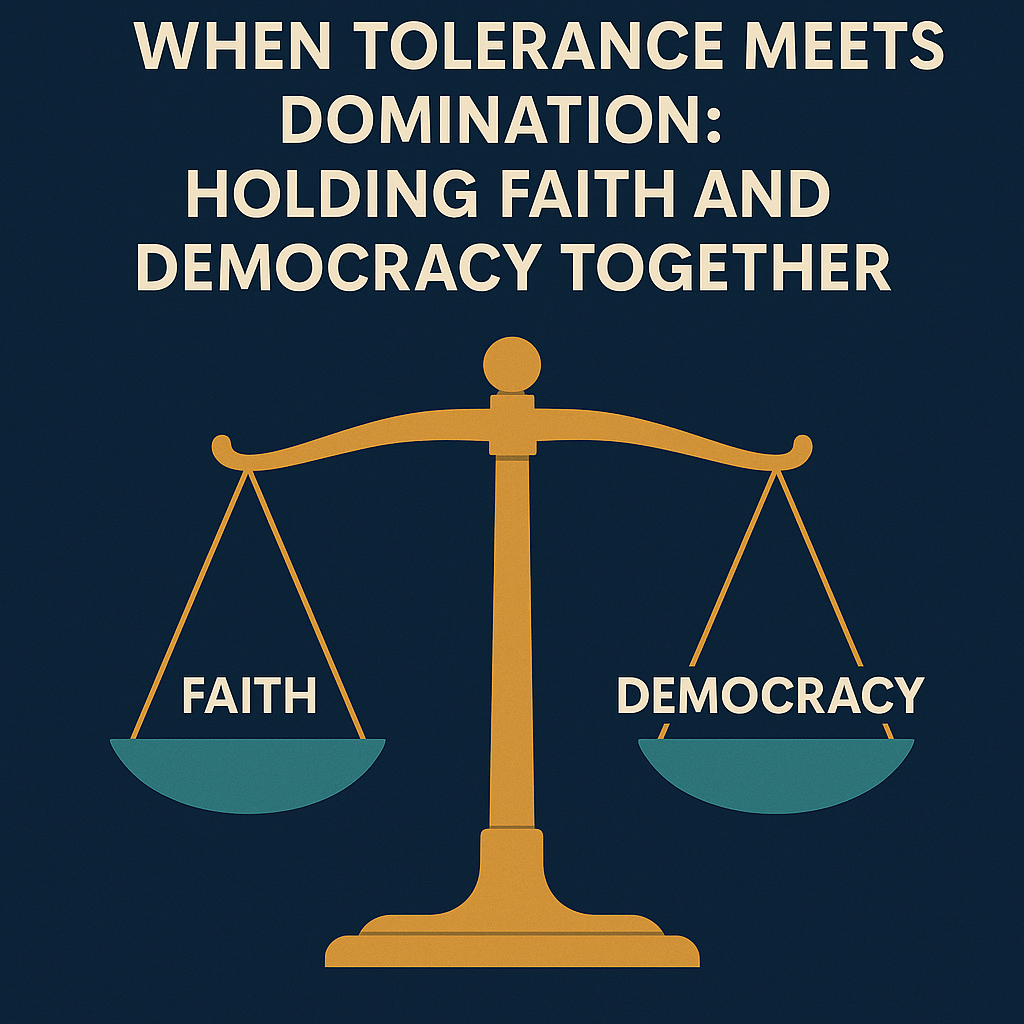
When Tolerance Meets Domination: Holding Faith and Democracy Together

A scale with the words faith on one side and democracy the other I’ve been reflecting on my own self-awareness regarding religious tolerance. Not the easy kind of tolerance where we simply agree to disagree, but the harder kind—the one that asks me to notice what’s happening in our public square and on our screens, and to name what I feel in my body. When I heard about the murder of Charlie Kirk, my first reaction was visceral. Not in celebration, but in recognition of how profoundly different my orientation to faith is from the one expressed by those around me. For me, God is love, and only love. Yet what I saw online and in conversations were Christians who framed their grief and their outrage from a theology that says Jesus loves, but God “hates what he hates.” Their mourning carried with it an expectation: that I should respond in kind. When I didn’t, the leap some made was that I must not be compassionate at all. That assumption was jarring.


The Leap of Intolerance

What took me by surprise wasn’t only the intensity of their conviction, but how quickly my refusal to mirror their expression was treated as a moral failure. The intolerance wasn’t subtle—it was immediate. And it compelled me to engage in a deeper practice of curiosity. I had to hold myself steady enough to ask, Where are they coming from? even as I knew I would not be persuaded. That’s the rub: to be curious enough to understand more fully, without filling in the gaps with my own projections or analysis. It also makes me question the kind of political analysis that collapses all Christians into a single category. Because if this experience revealed anything, it’s that there are profound and irreconcilable differences within Christianity itself. Shaped but Not Bound The strange thing is, I don’t even identify as Christian anymore. Still, my morality was shaped by a Christian upbringing, and I can’t deny how deeply those early teachings echo through my life. Over time, I’ve also been shaped by the wisdom of friends from diverse faiths, and by practices that have nothing to do with formal religion. My orientation isn’t perfect. It isn’t about claiming my path is the only one. It is simply my truth: God as love, rooted in dignity, in freedom, in compassion.

Freedom in Personal and Civic Life

What unsettled me in this moment was realizing how religious freedom—or the lack of it—touches the daily lives of people like me, who don’t actively practice a religion.
    • In my personal life, tolerance helps me stay connected to people who believe differently.
    • In my civic life, democratic protections keep me safe from being controlled by those who would dominate my choices in the name of their God.
Both matter. Both are fragile. Reflection Prompt for Leaders: Where in your life or leadership do you need to practice curiosity toward beliefs that differ from yours—while also drawing a clear boundary against domination? Stay well. Check the Resources section for a free handout with sample KPIs, and do reach out with any questions! Eva, MCH

When DEI Becomes a Lightning Rod: What Leaders Can Do

DEIB acronym with lightening striking it We’re living in a moment when DEI has become a lightning rod. For some organizations, that means a pause—or even a retreat. But a pause doesn’t have to mean silence. It can mean sharpening. When content is politicized, leaders can focus on what no one can take away: skills. Skills are the muscles of relationship that make workplaces sustainable and resilient:

    • Feedback and reflection: readiness to listen, courage to speak truth. Challenge yourself to build spaces where feedback is not only invited but acted on.
    • Presence and patience: slowing down to hear each other fully. Silence is often misunderstood. We treat it as a gap to be filled, but it is one of the most powerful leadership tools. Silence allows people to process, gather courage, or find language for what matters most. In my facilitation of Connection Circles, I’ve seen how the quietest moment can open the door for the most honest share. Practice letting silence carry weight in your next meeting.
    • Curiosity and humility: choosing learning over certainty. Ask a genuine question this week where you don’t already know the answer.
    • Resilience and spaciousness: tending to our nervous systems when conversations are charged. Notice your body’s response in a tough conversation, and practice grounding before you reply.
These aren’t “extras.” They’re the foundations of leadership and professional growth. In my work with schools and organizations, I’ve seen that the ability to connect with colleagues bolsters all growth. Connection makes the learning stick. As those responsible for professional development, we can adapt the tools we already know—circle practice, coaching frameworks, reflective journaling—and re-purpose them to strengthen these capacities. Content may be contested. Skills endure. And it is through skills that culture changes.

The Power of Spaciousness: Let Things Land

In a world obsessed with productivity and urgency, spaciousness is a quiet rebellion. It’s not absence. It’s not neglect. It’s not disconnection. Spaciousness is presence without pressure.

When we talk about space in the More Connected Humans™ framework, we’re naming three kinds: physical spacetime space, and emotional space.

Each one asks us to pause the rush—and in doing so, make room for something deeper to arise.

“Aerate / Permeate.”

I was honored to partner with Nature Sacred, a beautiful nonprofit that brings healing through nature to high-stress organizations. In one of our collaborations, I supported the development of guidelines for charrettes—community-based planning meetings that are rooted in equity and inclusion. One of the guiding principles we shaped together was:

This idea is steeped in spaciousness.

To aerate is to breathe air into something compacted, so that it can hold life again.

To permeate is to allow something to sink in, to move slowly and deeply through the layers.

In facilitation, leadership, and relationship, this looks like:

Not rushing people’s responses

Letting stories unfold in their own rhythm, even if multiple touch points are required

Listening without jumping to solutions or stories of our own

Making room for silence as a part of the conversation—not a problem

Spaciousness honors the invisible labor many people are doing at any moment.

Here are just a few reasons why someone might need space, without explanation:

• They are processing new or complex information

• They are self-regulating after a moment of emotional charge

• They are finding the courage to speak a hard truth

• They are searching for the right words

• They are stabilizing their nervous system after a past wound is touched

• It is cultural—a gesture of respect, humility, or sacred pacing

• It is a practice of self-preservation, especially for people navigating oppressive systems

• They are trying to stay connected without abandoning themselves

In these moments, space is not distance.

It is devotion.

It is care.

We do not offer space by backing away—we offer it by staying with, but not pressing.

Holding, but not directing.

Trusting, not timing.

Reflection Prompts for Spacious Leadership

(Use these to examine your own practices as a leader, facilitator, or colleague.)

1. How do I respond to silence? Do I see it as discomfort—or depth?

2. Do I give people time to reflect before responding in meetings or circles?

3. Can I stay present when someone’s pace is slower than mine?

4. How might I invite people to speak without demanding it?

5. What would it look like to trust that connection is happening, even in the quiet?

Spaciousness isn’t passive—it’s intentional.

It’s what makes emotional truth possible.

It’s what allows pain to soften, wisdom to surface, and connection to deepen.

Let’s remember:

We don’t need to fill the room to show we care.

Sometimes, it’s in the breathing room that allows the best work to arrive.