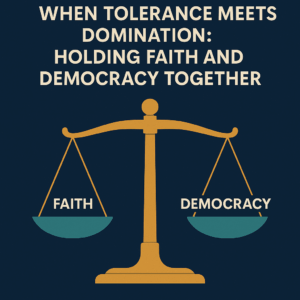
I’ve been reflecting on my own self-awareness regarding religious tolerance. Not the easy kind of tolerance where we simply agree to disagree, but the harder kind—the one that asks me to notice what’s happening in our public square and on our screens, and to name what I feel in my body.
When I heard about the murder of Charlie Kirk, my first reaction was visceral. Not in celebration, but in recognition of how profoundly different my orientation to faith is from the one expressed by those around me. For me, God is love, and only love. Yet what I saw online and in conversations were Christians who framed their grief and their outrage from a theology that says Jesus loves, but God “hates what he hates.”
Their mourning carried with it an expectation: that I should respond in kind. When I didn’t, the leap some made was that I must not be compassionate at all. That assumption was jarring.
The Leap of Intolerance
What took me by surprise wasn’t only the intensity of their conviction, but how quickly my refusal to mirror their expression was treated as a moral failure. The intolerance wasn’t subtle—it was immediate. And it compelled me to engage in a deeper practice of curiosity.
I had to hold myself steady enough to ask,
Where are they coming from? even as I knew I would not be persuaded. That’s the rub: to be curious enough to understand more fully, without filling in the gaps with my own projections or analysis.
It also makes me question the kind of political analysis that collapses all Christians into a single category. Because if this experience revealed anything, it’s that there are profound and irreconcilable differences within Christianity itself.
Shaped but Not Bound
The strange thing is, I don’t even identify as Christian anymore. Still, my morality was shaped by a Christian upbringing, and I can’t deny how deeply those early teachings echo through my life. Over time, I’ve also been shaped by the wisdom of friends from diverse faiths, and by practices that have nothing to do with formal religion.
My orientation isn’t perfect. It isn’t about claiming my path is the only one. It is simply my truth: God as love, rooted in dignity, in freedom, in compassion.
Freedom in Personal and Civic Life
What unsettled me in this moment was realizing how religious freedom—or the lack of it—touches the daily lives of people like me, who don’t actively practice a religion.
-
- In my personal life, tolerance helps me stay connected to people who believe differently.
-
- In my civic life, democratic protections keep me safe from being controlled by those who would dominate my choices in the name of their God.
Both matter. Both are fragile.
Reflection Prompt for Leaders:
Where in your life or leadership do you need to practice curiosity toward beliefs that differ from yours—while also drawing a clear boundary against domination?
Stay well. Check the Resources section for a free handout with sample KPIs, and do reach out with any questions!
Eva, MCH